
 Deutsch



Genetic analysis · ProVitalDNA: Weight Sensor: DNA test for weight loss
The Weight Sensor analyzes 8 genes associated with how the body processes fat and carbohydrates, with hunger and satiety, and with the response to exercise – a structured basis for your nutrition and weight-loss counseling.
Request a partnershipView the sample nutrition plan
- Saliva sample with the Saliva Kit
- Processing time 1–2 weeks
- For end customers: available through ProGenom partners

8 genes
analyzed from a saliva sample
6 topics
in the weight profile of the report
around 1,400
foods assessed for weight loss*
What is analyzed
What the genetic weight profile shows
The Weight Sensor is part of the ProVitalDNA line from ProGenom: a non-medical genetic analysis that summarizes its results on 8 genes in six topics.
Nutrition type
Fat, carbohydrate or mixed type – with a recommended distribution of fat, carbohydrates and protein.*
Exercise or calorie reduction
How effective exercise and calorie reduction are according to the genetic profile – plus the balance of endurance and strength.*
Preserving muscle mass
Whether there is an increased tendency to lose muscle mass during calorie reduction.
Hunger and satiety
Hunger, satiety and snacking type, plus the tendency to favor particularly high-calorie foods.
Fat distribution
Whether the genetic profile favors fat storage in the abdominal area.
Maintaining weight
How pronounced the tendency toward the yo-yo effect is and what matters afterward.*
Result example
What a result looks like in the report
The Weight Sensor report begins with an overview: each result appears as a tile with a scale, a short explanation and a reference to the chapter that explains it with study sources. Three examples from a sample report:
Example · Fat
Moderate fat sensitivity
The result suggests that larger amounts of fat calories tend to contribute to weight gain. Derived recommendation: eat a reduced-fat diet and favor unsaturated fats.*
Chapter: Nutrition type
Example · Carbohydrates
Low carbohydrate sensitivity
The ADRB2 result suggests that carbohydrate calories hardly contribute to weight gain. Derived recommendation: carbohydrates may provide the larger share of calories.*
Chapter: Nutrition type
Example · Maintaining weight
Weak yo-yo type
The result suggests a low tendency to regain weight quickly after losing it. Derived recommendation: keep following the basic rules of the report afterward.*
Chapter: Yo-yo effect
Nutrition typevery good carbohydrate utilizer
- 20 % Fat
- 60 % Carbohydrates
- 20 % Protein
Example · Nutrition type
Nutrition type result: very good carbohydrate utilizer
From the fat and carbohydrate results, the report derives the nutrition type and, from it, a recommended distribution of daily calories – in this example, more carbohydrates and less fat than is usually recommended.*
Chapter: Nutrition type
Examples from a German sample report, wording shortened and translated for the website. The dot shows where the result lies between limited and favorable.
Sample nutrition plan
Browse the sample nutrition plan
Building on the Weight Sensor result, the personalized nutrition plan with recipe book contains:
- Food list with around 1,400 foods in six rating levels*
- Item system for flexible daily menu plans*
- Snack list, daily menus and recipes*
The sample shows the nutrition plan including the recipe book. The recipe book is an add-on that is ordered separately; the food list is included with the Weight Sensor.
The sample nutrition plan is displayed via the external service Yumpu and only loaded after your consent.

This document is provided via the external Yumpu PDF viewer. To display it, content from Yumpu must be loaded, which may transfer data to the provider.
More informationProGenom study
2021 study: 2.4 times as much weight loss with the adapted program
In a study conducted by ProGenom with 300 participants, those on a nutrition and exercise program adapted to their Weight Sensor result lost an average of 3.5 kg – 2.4 times as much as on a standard weight-loss program based on the recommendations of the German Nutrition Society (DGE), on which they lost an average of 1.4 kg.
Weeks 1–3Standard program (DGE)
−1.4 kgon average
Weeks 4–5Break
no program
Weeks 6–8Adapted program
−3.5 kgon average
2.4 times as much weight loss with the adapted program
How the study was designed
The same participants completed both programs one after the other: three weeks of a standard weight-loss program based on the recommendations of the German Nutrition Society (DGE), a two-week break, then three weeks of a nutrition and exercise program adapted to their Weight Sensor result – without dietary supplements.
The report provides the basis for implementing such a program in your consultations.*
ProGenom study, 2021, 300 participants; standard program based on the recommendations of the German Nutrition Society (DGE). Means ± standard deviation, p < 0.001 in each case. The same participants completed both programs one after the other; without dietary supplements.
For nutritional counseling
The Weight Sensor in the counseling process
The Weight Sensor is available through ProGenom partners, for example in nutrition and weight-loss counseling. An example of how to use it – you decide on the order and focus yourself.
Goals and sample
Clarify the starting point and eating habits; saliva sample with the Saliva Kit, no blood draw.
Analysis in our laboratory
Our laboratory in Austria analyzes the 8 genes; processing time 1–2 weeks.
Discuss the result
Interpret the nutrition type, exercise profile and eating behavior together and derive the plan.*
Support and maintain
Use the food and snack lists in everyday life and address the yo-yo tendency in follow-up appointments.*
More for your practice: we offer our partners training in our Academy.
Partner inquiryGenetic analyses in nutritional counselingQuality and data protection
Add-ons
Designed for the Weight Sensor
The recipe book and NutriMe Weight Management build on the Weight Sensor result and are available only in combination with it.
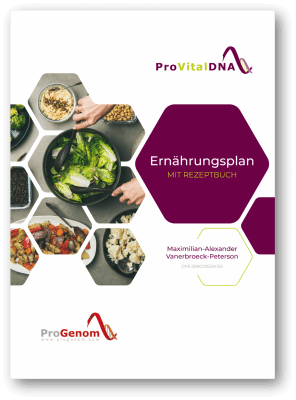
Recipe book for the Weight Sensor
Recipes and daily menus for the nutrition type*
What's included
- More than 30 individually compiled meal plans
- Over 100 recipes to cook at home
- Ingredients selected according to the genetic metabolic profile*
- Putting the recommendations into practice when shopping and cooking*
- Optionally as a printed book, personalized with the client's name
- Available only in combination with the Weight Sensor

NutriMe Weight Management
Dietary supplement matched to the genetic profile*
About NutriMe Weight Management
What's included
- Personalized portion sachets with the client's name, filled with small pellets
- Active ingredients: prickly pear cactus extract (Opuntia ficus-indica) and white bean extract (Phaseolus vulgaris)
- Dosage based on the Weight Sensor profile*
- Made in Austria
- Requires the Weight Sensor analysis
What it can show
What a DNA test for weight loss can do – and what it cannot
A DNA test for weight loss such as the Weight Sensor describes genetic predispositions and does not make a diagnosis. Its results show where counseling can start individually with nutrition, exercise and everyday life.*
What the Weight Sensor does: it shows how the genetic profile can influence metabolism, eating behavior and training, and translates this into clear recommendations for counseling.*
What it does not do: it does not make a diagnosis, does not treat overweight, obesity or metabolic diseases and does not guarantee weight loss. In cases of obesity or pre-existing conditions, weight reduction should be medically supervised. A weight-loss diet is generally not intended during pregnancy; eating disorders should be treated by physicians or psychotherapists.
Experiences
Experiences with the Weight Sensor
Feedback from users in our customer surveys in 2025 – on new insights into their own nutrition, the clarity of the report and more structure in everyday life.
“Finally no more guesswork! The Weight Sensor helped me change my diet in a targeted way. For the first time, I feel I really know what to pay attention to.”
Laura, 34Weight Sensor
“I always thought fats were my problem. The genetic analysis made me take a closer look at how my body processes carbohydrates for the first time. That was a real eye-opener!”
Thomas, 46Weight Sensor
“For years I tried different diets. The Weight Sensor helped me approach my diet more consciously and in a more structured way. Finally a concept I can actually work with!”
Markus, 52Weight Sensor
“I never thought my genetic characteristics could be so interesting for my diet. The report was easy to understand and gave me many new insights.”
Julia, 29Weight Sensor
“Finally I understand better what I want to pay attention to in my diet. No more constant trial and error, but a clear plan. That motivates me anew every day!”
Bettina, 47Weight Sensor
“2 kg in just two weeks! Since I adjusted my diet, I am finally seeing the first results. I am thrilled and incredibly motivated!”
Melanie, 38Weight Sensor
Feedback from customer surveys in 2025, translated from German and published with consent (first name, age). Individual experiences, results may vary; not evidence of a health effect.
ProVitalDNA
Further ProVitalDNA analyses for your consultations
The ProVitalDNA line includes further genetic analyses and lab tests: genetic analyses describe predispositions, lab tests the current status.

Nutrition Sensor
The genetic basis for personalized nutritional counseling
Looks at how the body handles nutrients – the broad complement to the weight profile.

Micronutrient Sensor
Current values instead of genetic predisposition
Indicators of vitamin, mineral and amino acid status – complementing weight-loss counseling.

Performance Sensor
Training and nutrition according to genetic predisposition*
Analyzes 26 genes related to strength, endurance and recovery – a good fit for weight goals combined with training.

Food Intolerance Sensor
IgG antibodies against foods – not proof of an intolerance
A lab result as a starting point for nutritional counseling.

Toxo Sensor
Genetic variants in detoxification processes
Looks at 10 genes, including oxidative stress – with suggestions for nutrition and lifestyle.*

Microbiome Sensor
Indirect laboratory indicators of gut health and nutrient absorption
Convenient, without a stool sample – a complement to nutritional counseling.

Biological Age Sensor
Gene variants related to telomere length
Complementing weight-loss counseling: suggestions for lifestyle.*

Allergy Sensor
Determining IgE sensitizations – not an allergy diagnosis
A laboratory basis for further clarification.

Burnout Sensor
Stress processing from a genetic perspective
Looks at a variant in the COMT gene and describes the genetic basis of stress processing.
Offer the Weight Sensor in your consultations
In nutrition and weight-loss counseling, you can offer the Weight Sensor as a ProGenom partner. Tell us briefly about your practice or business – a personal contact will get back to you.
Partnership free of charge – no minimum order and no start-up costs.
Start without prior knowledge of genetics – with training and a personal contact.
Request a partnershipYour benefits as a ProGenom partner
Training in the Academy · Marketing material · Partner portal & shop · Referral of end-customer inquiries
Looking for an analysis for yourself?
You can obtain the Weight Sensor through a professional – we will gladly refer you to a ProGenom partner near you. The analyses are available through our partners. End-customer prices are set by the respective partner.
Frequently asked questions about the Weight Sensor
Which genes does the Weight Sensor analyze?
The Weight Sensor analyzes 8 genes that studies have linked to how the body processes fats and carbohydrates, to hunger and satiety, to fat distribution and to the response to exercise and calorie reduction – including FTO, PPARG, FABP2, ADRB2 and ADRB3. The report groups the results into six topics: nutrition type, exercise or calorie reduction, preserving muscle mass, hunger and satiety, fat distribution and maintaining weight. For each topic, it lists the gene variants analyzed and the corresponding study sources.
How meaningful is a DNA test for weight loss?
The Weight Sensor describes genetic predispositions and is a basis for counseling, not a diagnosis – for example, whether someone responds more strongly to fat or carbohydrate calories or tends to snack frequently. Studies have described links between the gene variants analyzed and body weight and eating behavior; the report translates these links into specific recommendations for nutrition and training.*
Which clients is the Weight Sensor suitable for?
The Weight Sensor is suitable for people who want to lose or maintain weight with professional support – for example in nutrition or weight-loss counseling. The report gives counseling a structured starting point for nutrition and training recommendations.* In the case of illnesses and eating disorders, medical or psychotherapeutic care comes first; a weight-loss diet is generally not intended during pregnancy.
How do the Weight Sensor and the Nutrition Sensor differ?
The Weight Sensor focuses on body weight, eating behavior and training with 8 genes – from the nutrition type to the tendency toward the yo-yo effect. The Nutrition Sensor looks at how the body handles nutrients with around 50 nutrition-related genes and genetic markers. Both assess around 1,400 foods – the Weight Sensor with regard to weight loss, the Nutrition Sensor with regard to a healthy diet. If nutrient supply is also a focus alongside weight, the two analyses can be combined.
Interpreting the results
Statements marked with an asterisk are derived recommendations – logical conclusions.
Science: Several million scientific publications have already examined the effects of genes on the human body. That genes can influence, for example, body weight, the effectiveness of certain strategies, the ability to process certain nutrients or characteristics of the skin is supported for each gene analyzed in its respective area by several scientific studies – the genetic characteristics determined by our analyses are therefore based on scientifically established relationships.
Recommendations: The adjustments derived from these findings – to micronutrient dosing, cosmetic formulation and nutrition or lifestyle recommendations – have not yet been confirmed by randomized, placebo-controlled studies for every genetic effect. They should therefore be understood as logical conclusions – not as scientifically proven results – and do not replace medical advice, diagnosis or treatment.
The Weight Sensor is a non-medical genetic analysis and is not intended to diagnose diseases.
Figures on the numbers of genes and medications reflect the scope of each analysis at the time of writing and may be updated as science advances.